
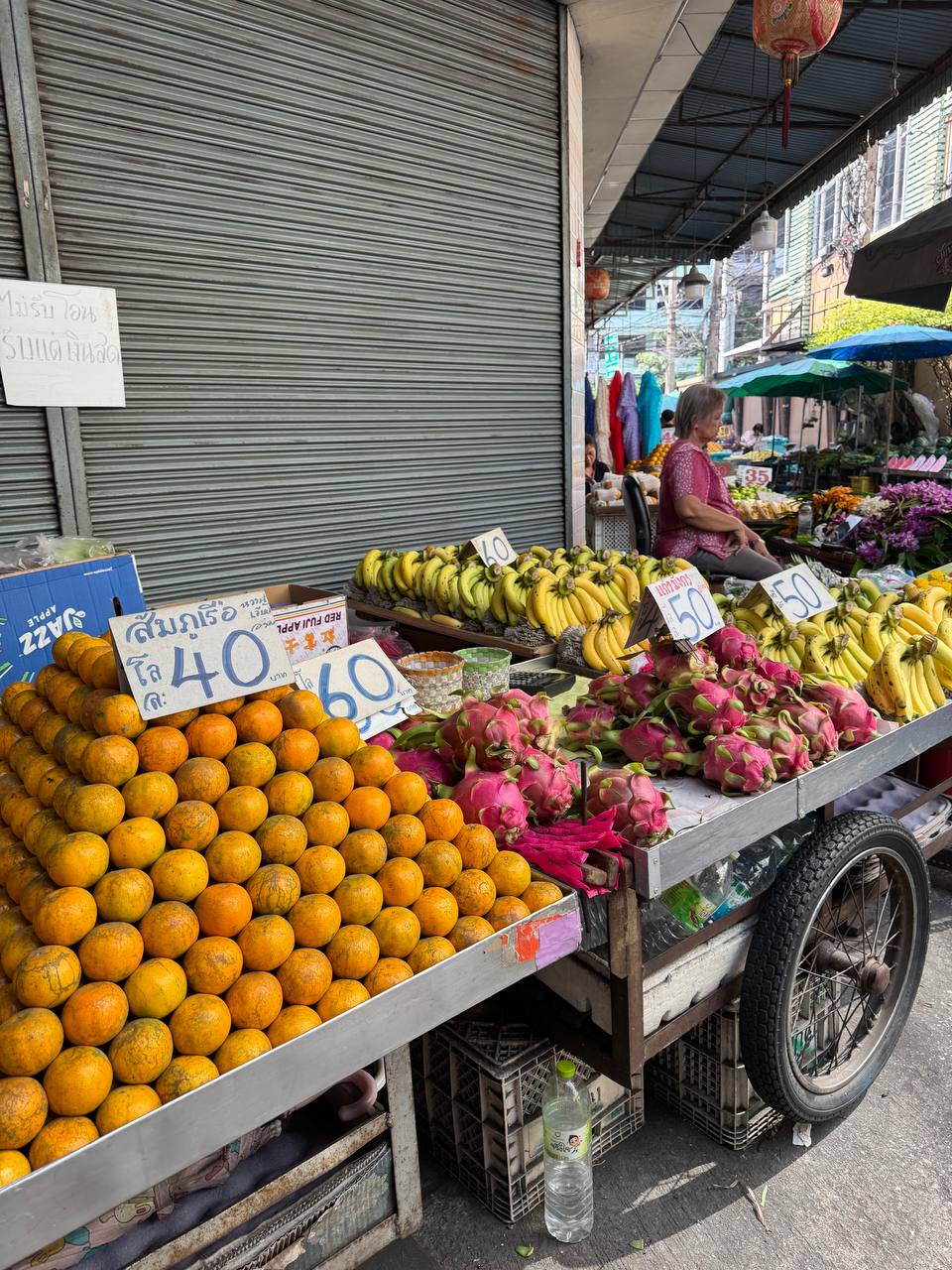
Bangkok markets come in three types: wet markets (04:00–05:00, cheapest, no English), Or Tor Kor (government, clean, English signs), and Chatuchak weekend market (15,000 stalls, Sat–Sun). Mangoes at a neighbourhood market run 40–80 THB/kg — about half the supermarket price. 7-Eleven fills the rest and works as everyday infrastructure.
In Bangkok a market isn't a tourist attraction, it's everyday infrastructure. I live here and shop at markets regularly — fruit, vegetables, coconut milk, sometimes ready-made food for dinner. Bangkok's markets work on several tiers: from the government-run Or Tor Kor with premium fruit, to the neighborhood wet market where chicken is 30% cheaper than at Tops. This Bangkok fresh markets guide for foreigners walks through the system: where to go for what, what it actually costs, and how not to look lost in front of a durian stall.
In Thai the word for market (ตลาด, talad) covers three completely different things, and it's worth not mixing them up.
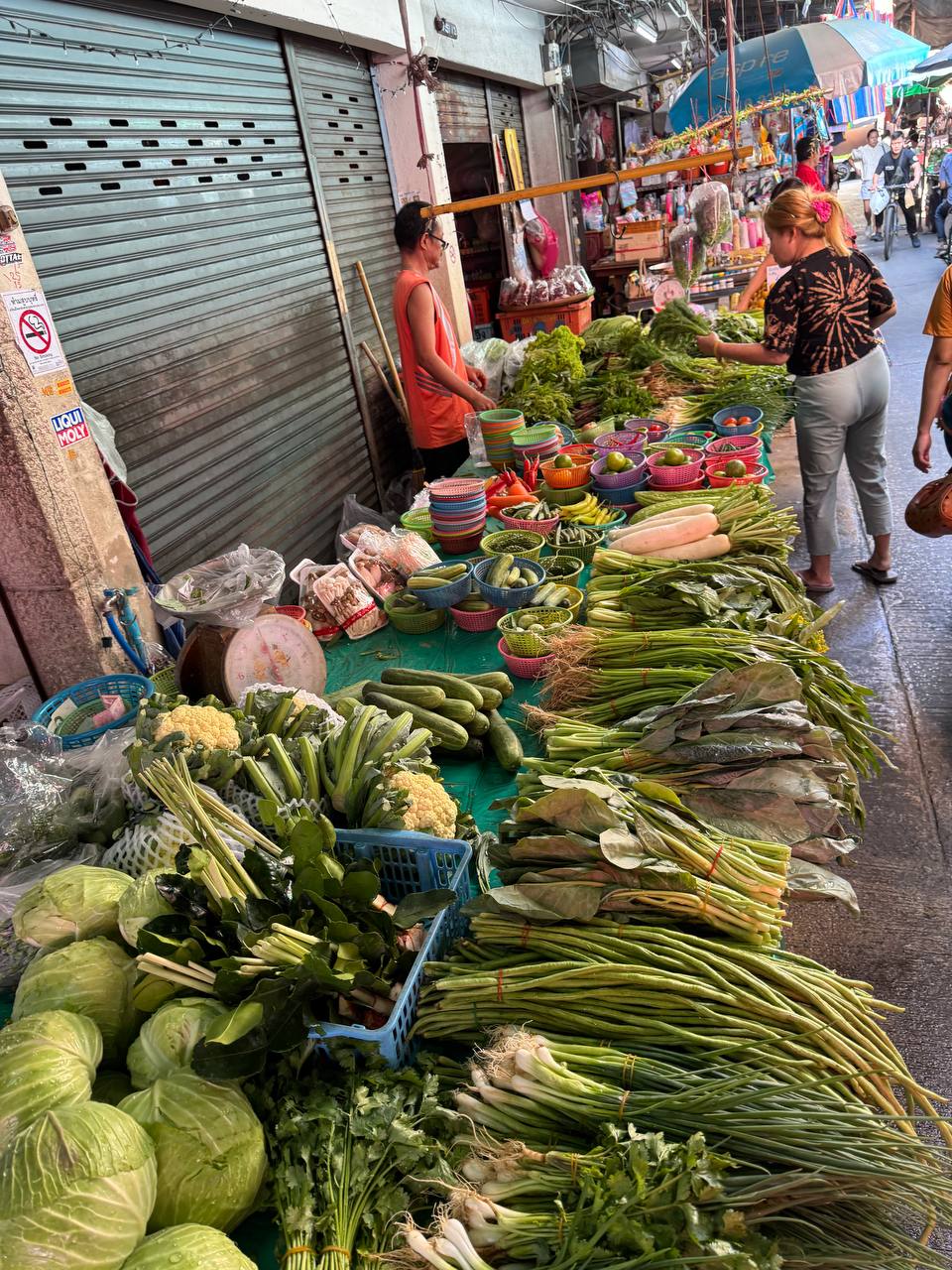
Wet markets are the daily fresh-food markets. Open from early morning, often 4–5 AM until noon. This is where you go for chicken, fish, vegetables, fruit, and rice. Prices are the lowest, but the format is the most spartan — wet floors, flies, no English signs.
Weekend markets are basically the Chatuchak phenomenon plus a couple of imitators. They run only on Saturday and Sunday, cover the area of a small town, and sell everything: clothes, plants, food, antiques, pets.
Night markets are my personal favorite. They open around 17–18, run past midnight, and the heat has dropped. The mood is relaxed and prices are lower than during the day. Talad Rot Fai on Ratchada is the one most expats know, but almost every district has its own.
I usually hop on the scooter in the evening and check what's open nearby. I don't have "my" market — I just go by what's closest at the moment.
If you're in your first week in Bangkok and want to understand what a Thai market even is, go to Or Tor Kor. It's the most civilized wet market in the city, and there's a reason it's the one foreigners get pointed to.
It's run by the government (Marketing Organization for Farmers). That means clean floors, AC in some sections, English signs, receipts, and vendors who aren't trying to slip you a bruised mango.
The quality is premium. Nam Dok Mai mango runs 80–120 THB/kg here (the same fruit at a street market is 40–80, but smaller and a lower grade). Mangosteen in season — 80–150 THB/kg, hand-picked. Seafood is fresh, with tiger prawns sitting on ice.
The downside: 30–50% more expensive than street wet markets, and haggling doesn't work — prices are fixed.
Address: Kamphaeng Phet Rd, directly across from Chatuchak. Easy to reach — MRT Kamphaeng Phet exit 3, or BTS Mo Chit (see the Bangkok public transport guide). Open daily roughly 7 AM to 6 PM.
One tip: there's a great food court in the middle of Or Tor Kor. Ready Thai food — curries, yums, desserts — at 60–80 THB a portion, all at a heat level a foreigner can actually handle. I sometimes drop by just for lunch.
Chatuchak isn't a grocery market, it's a phenomenon. Around 15,000 stalls, 35 sections, up to 200,000 people on a weekend day. Open Saturday and Sunday only, 9 AM to 6 PM.
Foreigners worry about getting lost. You won't. Chatuchak is laid out as a grid — sections are numbered, with main aisles between them (Soi 1, 2, 3...). Walk straight down any aisle and sooner or later you hit one of the four perimeter roads. I've been there many times and I always find my way out without drama.
What's where:
Chatuchak is a place where haggling does work. On clothes and souvenirs, knock 20–30% off the opening price. On food and plants — no.
Getting there: BTS Mo Chit (exit 1) or MRT Chatuchak Park / Kamphaeng Phet. Show up at 9 AM when it opens — by noon it's stuffy and packed. I wouldn't recommend coming here for a week's groceries; Chatuchak is about the experience and odd finds, not weekday shopping.
Every district in Bangkok has its own local wet market. Huai Khwang, Lat Phrao, On Nut, Bang Na — within a couple of kilometers of any BTS station you'll find a talad. This is the market you'll actually use once you've moved in and settled.
How to find yours:
fresh market or ตลาด within 1–2 km of home.My approach: zero loyalty to one place. In the evening I get on the bike, ride around, find what's open. On weekdays I go to whatever's closest, on weekends I sometimes stop by Or Tor Kor if I'm headed that way anyway.
After five years in Bangkok I've got a clear list.
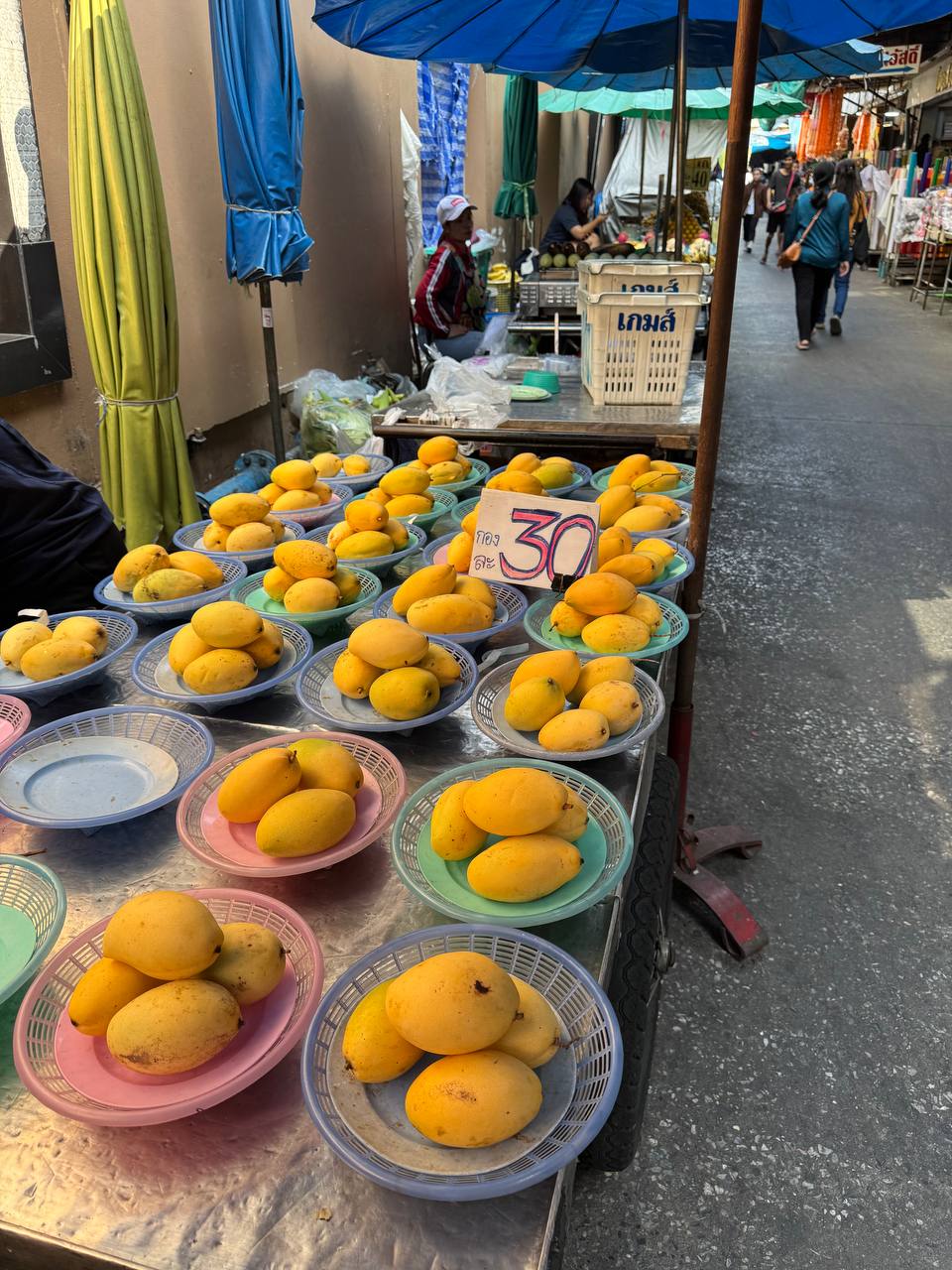
I buy at the market:
I don't buy at the market:
On durian. I've tried it. The taste is like fried eggs with caramelized onions, very specific. No addiction formed. I eat it rarely, and only when I see the vendor cutting the fruit in front of me and it smells sweet rather than chemical. If you do buy one — don't bring it home and definitely not into a hotel: the smell stays in the AC for a full day. Plenty of hotels and taxis fine you for durian in the cabin.
Cheaper than I expected. Mango. In Europe a single mango runs 3–4 euros, here a kilo is 1.5 euros. I eat mango every day in season. Dragonfruit, rambutan, mangosteen — all the things that sit in Berlin like delicacies, here they're everyday food.
Not cheaper. Imported goods — avocado, cheese, any European brands. Markets don't carry them at all, get those at Tops or Villa Market.
Cash. Most wet markets are cash-only. Or Tor Kor partly accepts PromptPay QR, Chatuchak too in places. Bring 500–1000 THB in small notes — street vendors often can't break a 1000.
Language. English is fine at Or Tor Kor and Chatuchak. At a neighborhood market — zero. The fix is simple: point at what you want, the vendor punches the price into a phone calculator, you nod or shake your head. Works 100% of the time.
Useful words:
Haggling. Not on fresh food. Prices are fixed and not up for discussion. On non-food (clothes, souvenirs, household stuff) — yes, knock 20–30% off.
Best timing.
Here's a table from my own budget (prices as of May 2026, can drift).
| Product | Wet market | Tops / Lotus | Difference |
|---|---|---|---|
| Mango (1 kg) | 40–80 THB | 60–120 THB | ~40% |
| Tomatoes (1 kg) | 30–50 THB | 40–80 THB | ~30% |
| Chicken (1 kg) | 80–100 THB | 100–130 THB | ~20% |
| Rambutan (1 kg) | 30–50 THB | 50–80 THB | ~50% |
| Fresh coconut milk | 30 THB | canned only, 45 THB | — |
The logic: anything fresh and seasonal — market. Anything packaged, frozen, or imported — supermarket. My split is roughly 70% market, 30% (meat, dairy, household, imports) Tops or Macro.
Electricity and fuel in Bangkok have gone up noticeably over the past five years — fuel went from 32 to 42 THB/liter. Food hasn't. The market is still the most stable segment by price, and it's one reason living in Bangkok is still cheaper than any European capital.
Or Tor Kor. It's government-run, clean, has English signs, and the vendors are used to dealing with foreigners. Prices run higher than street wet markets, but the quality and comfort are worth it for the first few weeks while you're still figuring out what's what.
No. Fruit, vegetables, and meat have fixed prices — bargaining is seen as odd and doesn't really work. Haggling makes sense at Chatuchak for clothes and souvenirs, and sometimes at night markets for non-food items. Not for groceries.
Some stalls at Chatuchak and Talad Rot Fai accept PromptPay via QR. At wet markets and Or Tor Kor it's almost all cash. Carry 500–1000 THB in small notes — many vendors can't break a 1000.
I buy meat at Macro, BigC, or Tops. At wet markets it sits unrefrigerated at +33°C, and you can't verify the date or where it came from. Chicken is borderline acceptable since it sells out by lunchtime. Pork and beef — supermarket only.
If you've just arrived — start at Or Tor Kor to learn the format without stress, then find your neighborhood market and forget the supermarket fruit aisle. Hit Chatuchak once for the experience, then don't go back until friends visit. That's the normal Bangkok routine: the market is part of daily life, not a sightseeing stop.
See also: Lumpini Park, Bangkok river boat transport, Bangkok expat guide, the Thailand section.
Part of the series
Bangkok Expat Guide 2026: Long-Term Living in the City
