
Bangkok for long-term residents runs on different logic than Bangkok for tourists. A studio near BTS costs 12,000–27,000 THB depending on neighbourhood — On Nut for value, Sukhumvit for convenience. Monthly budget from 40,000 THB. This guide covers where to live, how to move, and what the city actually looks like after a year.
This is a Bangkok expat guide written from inside the city, not from a hotel window. I live in Bangkok and most of what's in here is what I'd actually tell a friend who's just landed for a month, a year, or for good. The city looks like chaos for the first week and then quietly turns into one of the most liveable megacities in Asia — once you know where to live, how to move, and what to ignore. Below: neighbourhoods, transport, markets, parks, day trips, festivals, and the parts of long-term life in Bangkok that almost nobody puts in the tourist guides.
A week in Bangkok and a month in Bangkok are two different cities.
The week-long version is Khao San at night, the Grand Palace in the morning, a tuk-tuk that overcharges you, a rooftop bar, maybe a cooking class. It's the version Lonely Planet sells, and it's fine — but it's also the version that sends people home saying "Bangkok is fun for three days." That's true. The city wears thin if all you do is the loop.
What changes after a month is mundane. You stop eating at restaurants with English menus. You learn which 7-Eleven near your condo has the freshest sandwiches. You figure out that the BTS is for some routes and a motorcycle taxi is for others. You stop reaching for Google Maps every time you leave the building.
After three months you have a barber, a coffee place, a fruit lady at the market who remembers what you bought last time. You stop noticing the heat the way new arrivals do — your body just slows down between noon and four. You learn that "ten minutes by car" in Bangkok can mean forty in traffic, and you plan accordingly.
After a year, the city is your city. You have favourite parks at specific times of day, a cheap som tam place that's better than anything on Time Out's list, and a route home that avoids the three intersections that always lock up at 18:30.
The difference between tourist Bangkok and resident Bangkok is mostly logistics. The tourist version is loud and expensive because everything is happening on someone else's terms. The resident version is quiet, cheap, and very easy — once you've put in the time.
Pick a neighbourhood by what you want your weekday to look like, not by what shows up first on Airbnb.
Sukhumvit is the default for most expats and the most expensive way to live here. The strip from Asok to Ekkamai is BTS-served the entire way, full of condos, malls, restaurants, gyms, coworking spaces, and other foreigners. Asok–Phrom Phong is the priciest stretch. Convenient, sterile in a useful way, and you basically never have to learn Thai if you don't want to. A studio runs 25,000–45,000 THB depending on the building.
Thonglor and Ekkamai are Sukhumvit with a design budget — younger, more bars, more brunch, more dogs. Same BTS line, slightly less corporate.
Silom and Sathorn are the business district. Office towers during the day, bars and night markets after dark, and the only part of central Bangkok where you can walk to Lumpini Park in fifteen minutes. Good if you work in finance or want to live near the river. Slightly older, slightly quieter than Sukhumvit.
On Nut, Bang Chak, Bearing are the BTS extension going south-east. Same train line, much cheaper rent. A clean studio at On Nut runs 12,000–18,000 THB. You trade twenty minutes on the BTS for half the rent — for most people that's a good trade. This is where a lot of long-termers end up after the first year.
Huai Khwang and Lat Phrao are MRT districts, residential, mostly Thai and Chinese, very few westerners. Big fresh markets, cheap food, good local feel. If you want to live in Bangkok rather than in the expat bubble, this is the better option.
Ari is the writer's pick. North on the BTS Sukhumvit line, low-rise, walkable, full of cafés and small restaurants. More Thai than Sukhumvit, more interesting than Lat Phrao, more expensive than On Nut. Very easy to like.
Old Town and Rattanakosin — temples, river, no metro to speak of. Beautiful to visit, hard to live in unless you specifically want it.
The single rule that matters: be within 500 metres of a BTS or MRT station. Bangkok punishes anything further than that, especially in your first six months when you don't yet have a bike.
Bangkok doesn't have one transit system. It has six, running in parallel, and the trick is knowing which one to use when.
For a first week, the answer is simple: BTS plus Grab. BTS for anything along Sukhumvit, Silom, or up to Mo Chit. Grab for everything else — fixed prices in the app, no haggling, no explaining the address in broken Thai. A Rabbit Card from any BTS station is 200 THB and now works on the MRT Blue Line as well. Get one on day one.
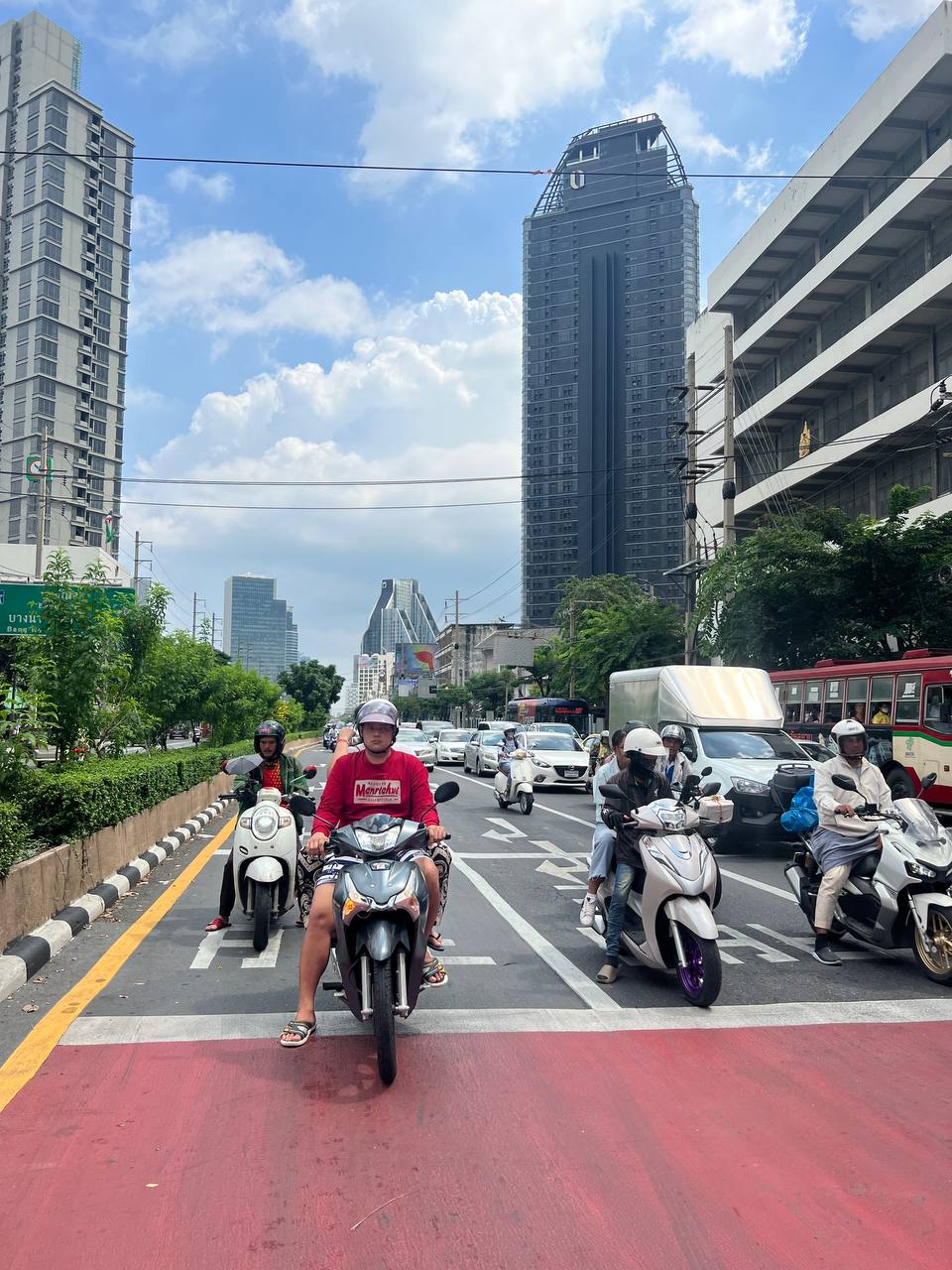
By month three, your toolkit expands. Motorcycle taxis — the guys in orange vests who park outside every BTS exit — solve the last-mile problem. 10–40 THB for a short hop, and they fit through traffic in a way nothing else does. Metered taxis still exist; they're cheap if the meter is on, and the easiest way to spot a bad one is the driver who refuses the meter and quotes a flat fare. Walk away.
Buses are 8 THB, no air conditioning on the vintage fleet, and the routes make sense only after you've lived here a while. Not for daily use — but they're unmistakably Bangkok. Every route has its own colour: orange, pink, blue, blue-and-white.

Orange bus number 2 under the BTS overpass — Bangkok's most common colour
Tuk-tuks are a tourist novelty — more expensive than a metered taxi, hotter, slower in traffic, and the classic scam where the driver "knows a great suit shop" still works on people thirty years after it was first written about.
If you're staying long-term, a small 110–125cc scooter changes everything. Cheaper than Grab, faster than the BTS in many situations, parks anywhere for free. Not a week-one decision — you need an international license, time to learn the road, and a couple of months of just watching how Thai traffic actually flows. But after that, it's the single biggest quality-of-life upgrade Bangkok offers. Full breakdown in my Bangkok public transport guide.
The river is its own system. The orange-flag Chao Phraya boats run from Sathorn Pier up past the old town for a flat 15 THB and don't care about traffic. For Wat Pho, Wat Arun, and the Grand Palace, the boat is faster and cheaper than anything on land. Khlong Saen Saep is the canal version, running through the middle of the city — packed at rush hour but it moves. I wrote a separate Bangkok river boat guide for the routes, flag system, and which piers actually matter.
My current weekday mix: 80% scooter, 10% Grab when it rains, 5% BTS when parking would be a nightmare, 5% motorcycle taxi when I'm somewhere without my bike.
You need parks more than you think. Bangkok runs hot, the sidewalks are uneven, and after a week of malls and BTS stations the city starts to feel like one continuous interior. Parks are the reset.
Lumpini Park is the obvious starting point. 57 hectares between MRT Lumpini and BTS Sala Daeng, free, open from 04:30 to 21:00. Three things make it worth going regularly: monitor lizards (real two-metre ones, especially near the lakes in the early morning), the morning tai chi crowd, and the Royal Bangkok Symphony Orchestra's free Sunday concerts on the open-air stage from mid-December to late February. Bring a mat, arrive an hour early, sit on the lawn ten metres from a full orchestra. There is no European city where this is a normal Sunday. Full details in my Lumpini Park guide.
Benjakitti is the one I like more than Lumpini and the one I send people to when they ask. A big oval lake with elevated wooden walkways through reed beds, herons, a wetland zone, and skyscrapers behind it at sunset. Easier to fall in love with than Lumpini. Ten minutes by Grab from Asok.
Chatuchak Park sits next to the weekend market and is good for a half-hour decompress between buying things you don't need.
The other parks worth knowing: Rot Fai in the north for cycling on real bike paths, and Saranrom in the old town if you're already at Wat Pho.
If you can only do one in your first week — Benjakitti at sunset.

Benjakitti Park promenade at night — elevated walkway with Asok skyline
Markets in Bangkok aren't a sightseeing stop. They're how you buy fruit, vegetables, and dinner.
There are three categories and they don't overlap.
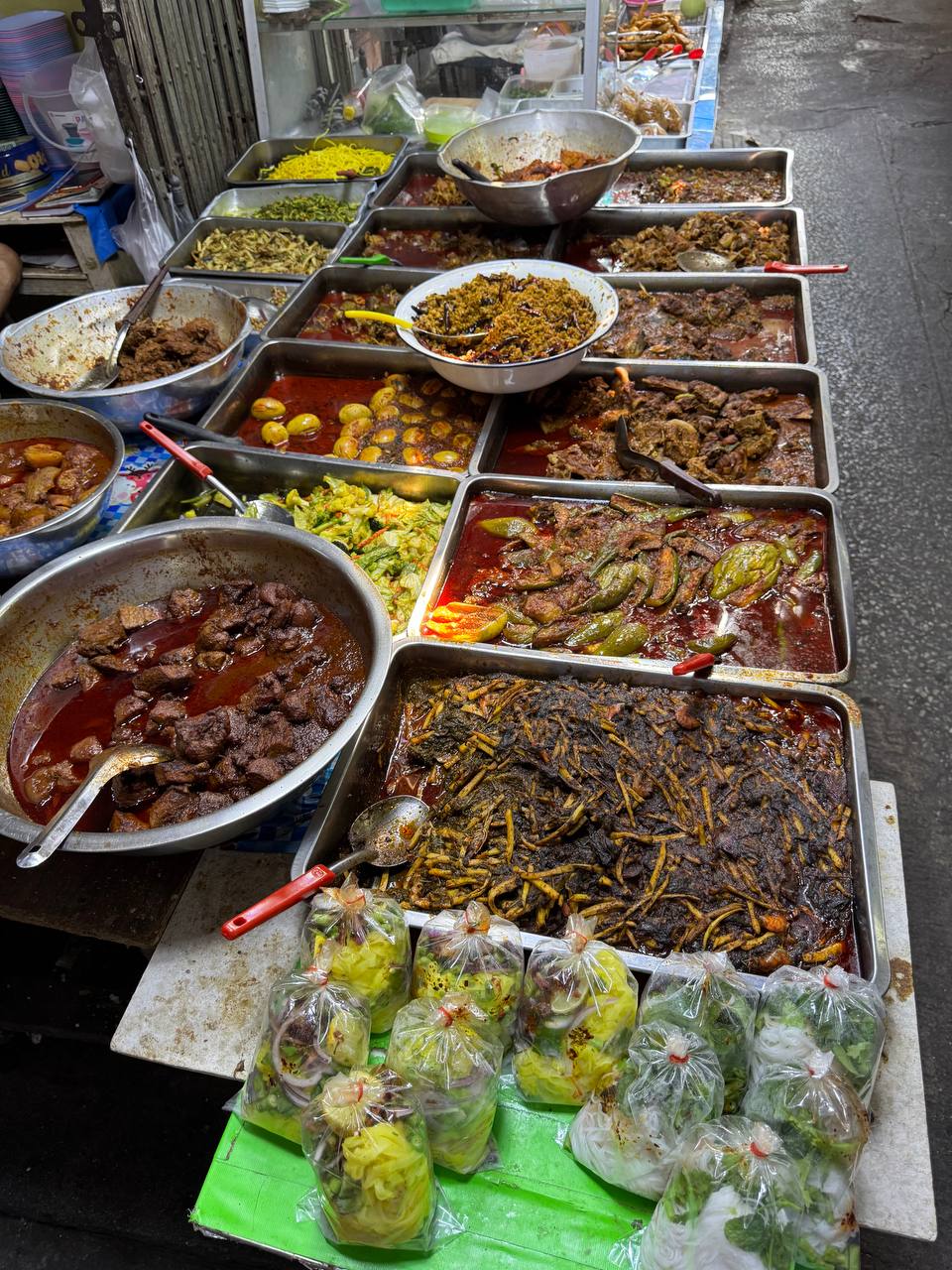
Wet markets are the daily fresh-food markets. Open from 04:00 or 05:00 in the morning until noon. Chicken, fish, vegetables, fruit, sometimes prepared food. Cheapest prices in the city, no English signs, and the floor is wet because it's a wet market. Every neighbourhood has one — Google Maps "fresh market" or the Thai ตลาด within 1–2 km of your condo and you'll find it.
Or Tor Kor is the wet market with training wheels. Government-run, clean, English signs, premium fruit, fixed prices, slightly more expensive than a street market but considerably less stressful. Across from Chatuchak, MRT Kamphaeng Phet exit 3. The food court inside is a great cheap lunch.
Chatuchak Weekend Market is something else entirely. 15,000 stalls, weekends only, 09:00–18:00. Clothes, plants, food, antiques, everything. Not a grocery market. You go once for the experience and after that only when friends visit.
Night markets open around 17:00 and run past midnight. Talad Rot Fai on Ratchada is the famous one; almost every district has its own.
What I buy at markets: all fruit (mango at 40–80 THB/kg, half supermarket price), vegetables, fresh coconut milk, ready-made curries and som tam. What I don't buy at markets: meat (sits at +33°C all morning — get pork and beef from Tops, Macro, or BigC), seafood except at Or Tor Kor, anything dairy.
Cash only at most stalls, English varies wildly (Or Tor Kor and Chatuchak are fine, neighbourhood markets are point-and-calculator), no haggling on fresh food. Full version in my Bangkok fresh markets guide.
7-Eleven is the other half of food infrastructure. There's one every 200 metres, they sell decent sandwiches, frozen meals you microwave on the spot, fresh fruit, coffee, SIM cards, and you pay your electricity bill there. It is genuinely better than 7-Eleven anywhere else in the world. New arrivals laugh; six months later you stop in three times a day.
Street food is mostly safe if the place is busy. The rule that's served me well: if a stall has a queue of Thais at lunch, eat there. If it has a tour bus parked outside, don't.
After a few weeks you'll want a day out of the city, and the obvious answer is Ayutthaya — 70 km north, the former capital of Siam, founded in 1350, sacked by the Burmese in 1767, and now a UNESCO site of brick chedis, ruined wats, and a stone Buddha head wrapped in banyan roots that everyone has seen on Instagram.
The train is the way to go. Sixteen runs a day from Bang Sue Grand, plus eleven from Hua Lamphong. Third class with ceiling fans is 20 THB and looks like a colonial-era movie. Second class with AC is around 250 THB. Two hours either way. A minivan from Mo Chit is faster on a perfect day and stuck in traffic on a normal one.
The combined temple ticket is 220 THB and pays for itself at the third stop. My ranking: Wat Phra Si Sanphet for the three white chedis, Wat Ratchaburana for the underground frescoes, Wat Yai Chai Mongkon for the climb. The famous Buddha head in the tree at Wat Mahathat is overrated — give it 30 seconds and move on. Rent a bicycle for 80 THB at the station; walking the temple loop in 33°C heat is a mistake I made so you don't have to. Full route, what to skip, and what I'd do differently in my Ayutthaya day trip guide.

Wat Phra Si Sanphet at sunset — the main chedi of Ayutthaya's former royal temple
Other doable day trips: Kanchanaburi for the Death Railway and waterfalls (best with an overnight), Pattaya if you want the sea and don't mind the seediness, Amphawa floating market on weekends. Hua Hin needs at least a Friday-to-Sunday. Khao Yai National Park is a long day but possible.
If you've got two free days, fly to Chiang Mai instead — flight from Don Mueang is 45 minutes and 1,000–2,000 THB.
Two festivals are worth structuring your year around.
Loy Krathong falls on the full moon of the 12th lunar month — November every year, with the date shifting. In 2026 it's Wednesday, 25 November. The whole country goes to the water with small banana-trunk rafts decorated with flowers, candles, and incense, and floats them away with whatever they want to leave behind from the past year. Bangkok's main spots are along the Chao Phraya near Saphan Taksin and Asiatique, but Benjakitti and Lumpini both have ponds and considerably less crush. Krathongs are 20–100 THB at any street stall on the night.
The mix-up I see every year: Loy Krathong is the nationwide water festival. Yi Peng is the northern lantern release in Chiang Mai — the photos with thousands of paper lanterns in the sky. Two different traditions, overlapping dates. Bangkok bans mass lantern releases because of the airports, and that's the right call. If you want lanterns, fly to Chiang Mai for the 24th and 25th. Book hotels two months out — prices double. Full breakdown in my Loy Krathong festival guide.
Songkran in mid-April is the Thai New Year and the biggest water fight on earth. Three days, officially 13–15 April, in practice longer. Whole streets shut down for organised water battles — Silom, Khao San, Sukhumvit Soi 11. If you don't want to get wet, do not leave the condo. If you do, dress for it and put your phone in a waterproof bag. Songkran is also the hottest week of the year — 38–40°C is normal — which is the whole point of the water.
Smaller ones worth knowing: Chinese New Year in Yaowarat (late January or February), the Royal Ploughing Ceremony in May, Vegetarian Festival in October.
The bigger festival logic for residents: the city becomes hard for a couple of days, plan around it. Don't book important meetings during Songkran, don't try to drive across town on Loy Krathong night, accept that deliveries will be late.
The Bangkok that rarely makes it into guides is the weekday version — the one with no rooftop bars in it.
The April heat. April is when Bangkok turns brutal. 38–40°C, humidity that doesn't quit, asphalt soft enough to leave a footprint. The city slows down between 11:00 and 16:00 and you slow down with it. Locals plan their day around shade and AC, and after a year here you do too. It's also the most beautiful time of evening — the air at 19:00 is suddenly soft, the streets fill up, everything reopens.
The October floods. End of rainy season. Heavy storms can flood streets to ankle or knee depth in twenty minutes and drain again in two hours. It's not catastrophic — Bangkok handles it — but it's a thing that happens, and your shoes will get wet. Have a pair you don't care about.
Sunday mornings. The best version of the city. Roads are quiet, parks are full, the markets are open, the heat hasn't peaked yet. If you want to fall in love with Bangkok, go to Chatuchak Park or Benjakitti at 07:00 on a Sunday and walk for an hour.
The construction noise. Something is always being built next to where you live. Pile drivers start at 08:00 and go until evening. Pick a condo that's not next to an active site, and check the BMA construction map before signing a lease.
The pollution. PM2.5 is bad from January to April — sometimes very bad. Buy an air purifier for the bedroom (3,000–8,000 THB at any electronics shop) and check the AQI before deciding whether to run outside. The rest of the year the air is fine.
Visa runs and paperwork. This is the part nobody photographs. Whatever visa you're on requires renewals, 90-day reports, sometimes border runs. The system works but it has its own logic, and Reddit's r/ThailandTourism plus a good visa agent are worth more than any blog post on the subject.
Loneliness and the bubble. The expat scene in Bangkok is friendly and shallow. People come and go on six-month cycles, friendships form fast and dissolve faster. The fix is to make Thai friends, learn enough of the language to have a conversation at a bar, and live somewhere that isn't 100% expats. Otherwise the city stays foreign for as long as you do.
The honest summary: Bangkok is one of the easiest cities in Asia to live in, and one of the hardest to get out of. It's cheap relative to anywhere I've lived in Europe, the food is genuinely good every day, the medical system works, the people are kind, and the airport flies everywhere. The traffic is bad, the pollution is real, the bureaucracy is its own thing. Net positive, by a wide margin.
A basic comfortable month runs from 40,000 THB — studio in a non-central district, eating mostly at markets and local restaurants, BTS and Grab. Add shopping malls, taxis and regular restaurants and the budget doubles easily. No real ceiling.
Anywhere within 500 metres of a BTS or MRT station. Navigating the city via metro is far easier than via streets. Sukhumvit is convenient but expensive; On Nut and Bearing are cheaper and quieter with BTS still nearby; Huai Khwang and Lad Prao are good if you want a residential feel without the expat overlay.
First weeks: BTS plus Grab. BTS covers the main routes without traffic, Grab handles everything else without negotiation or explanation. Add motorcycle taxis for short last-mile trips once you're oriented. If you're staying long-term, a small motorbike changes everything — cheaper, faster, parks anywhere.
One of the safest megacities in Asia for tourists. Street crime is low, locals are friendly. The real risks are pickpockets in crowds and tourist traps — the tuk-tuk that takes you to a gem store, the "temple is closed today" guy near Wat Pho. Keep your head and don't trust strangers offering deals near tourist sites.
Yes. June–October rains are short — usually an hour or two in the afternoon, then sun again. Fewer tourists, lower prices. Downside: occasional street flooding and some outdoor activities are harder to plan. Best time for waterfalls — Thi Lo Su in the north is at its peak in November, just after the rains.
In this series


