
Getting around Bangkok depends on where you are in your stay. Week one: BTS and Grab — fixed prices, no negotiation. Month two: motorcycle taxis (orange vests, 10–40 THB) fill the last-mile gaps metro can't reach. Long-term residents usually get a scooter. Buses exist at 8 THB but are reliably slow.
This Bangkok public transport guide for foreigners is what I'd tell a friend showing up for a month or moving here for good. The city doesn't have one transit system — it has six running in parallel. BTS, MRT, buses, taxis, Grab, motorbikes, river boats, tuk-tuks. Each has its niche, and there's no single answer to "how do I get around Bangkok."
I live here and have owned a car, a big motorcycle, and a small one — and tried almost everything that moves on these streets.
Spoiler upfront: if you're staying long-term and willing to get a license, a small motorbike beats everything else. But it's not for everyone, and definitely not for week one.

Orange bus number 2 at a Bangkok stop under the BTS overpass
I've owned all the options. The Toyota was comfortable, but in Bangkok you sit in traffic with everyone else. A big motorcycle (400cc and up) has power, but in dense traffic that's a downside — it doesn't squeeze between cars, burns more fuel, and you're more likely to clip someone's mirror. A small 110–125cc scooter turned out to be the sweet spot.
It fits where nothing else fits. Parking is everywhere and basically free. Fuel costs are negligible, even at 42 THB per litre (it was 32 a year ago — that change is noticeable).
But honestly: a small bike is ideal for distances up to 15–20 km inside the city. If your daily run is to Ayutthaya or out to the coast, you don't have the power, and a 110cc on the highway is a questionable pleasure. My personal formula: long trips by car or train, medium ones on a proper motorcycle, daily 15 km errands on the small scooter.
I don't recommend a motorbike for a week-long visitor. You need an international license, the road rules here are their own thing, and the first month you'll tense up at every intersection. That's normal — I needed time too.
The BTS Skytrain runs on elevated tracks above the main avenues. Two lines: Sukhumvit (dark green) and Silom (light green). The MRT is underground, with the Blue Line covering Chinatown, Hua Lamphong, and part of the centre.
Prices: BTS is 17–65 baht per ride, MRT is 16–42 baht. By Bangkok standards that's expensive. A short motorcycle taxi often costs less and arrives faster, especially if reaching the BTS station means a 700-metre walk in the sun.
Cards. Get a Rabbit Card for BTS — 200 baht at any station (100 deposit, 100 balance). Since 2020 the Rabbit also works on the MRT Blue Line, which is convenient. The Mangmoom card is an alternative at around 180 baht, but Rabbit covers more.
Hours: BTS runs roughly 05:30 to midnight, MRT from 06:00 to midnight. After midnight your only options are taxi or motorcycle taxi.
When I personally use BTS: rush hour, when I'm heading to a station-adjacent area, and ground-level traffic is a disaster. The rest of the time it's often cheaper and faster to take a moto-taxi to the nearest BTS, ride one stop, and walk — that combo works.
Grab is the local Uber equivalent and at this point it's the default in Bangkok. App, fixed price, card or cash payment, no need to explain anything to the driver. It runs roughly 1.5–2x the metered fare.
A regular taxi (pink, green-yellow, or blue) is cheaper: 35 baht to start, then around 5.5 baht per kilometre. Crossing half the city costs 60–150 baht. If the driver turns the meter on, you're fine. If they quote you a flat rate, walk away and flag the next one.
In five years here I've taken a regular taxi exactly once. The fare was 40 baht, on the meter, no surprises. Once — because I have my own bike and there's no point. If I didn't, I'd default to Grab: predictable, no address-explaining, no haggling, driver ratings.
For a new arrival: Grab. Period. You'll save your nerves and avoid the drivers who "don't speak English, but for 300 baht I understand everything."
BMTA city buses are the cheapest transport in Bangkok. Non-AC buses are 8 baht for any distance. AC buses run 12–25 baht. For context, that's less than a bottle of water at 7-Eleven.
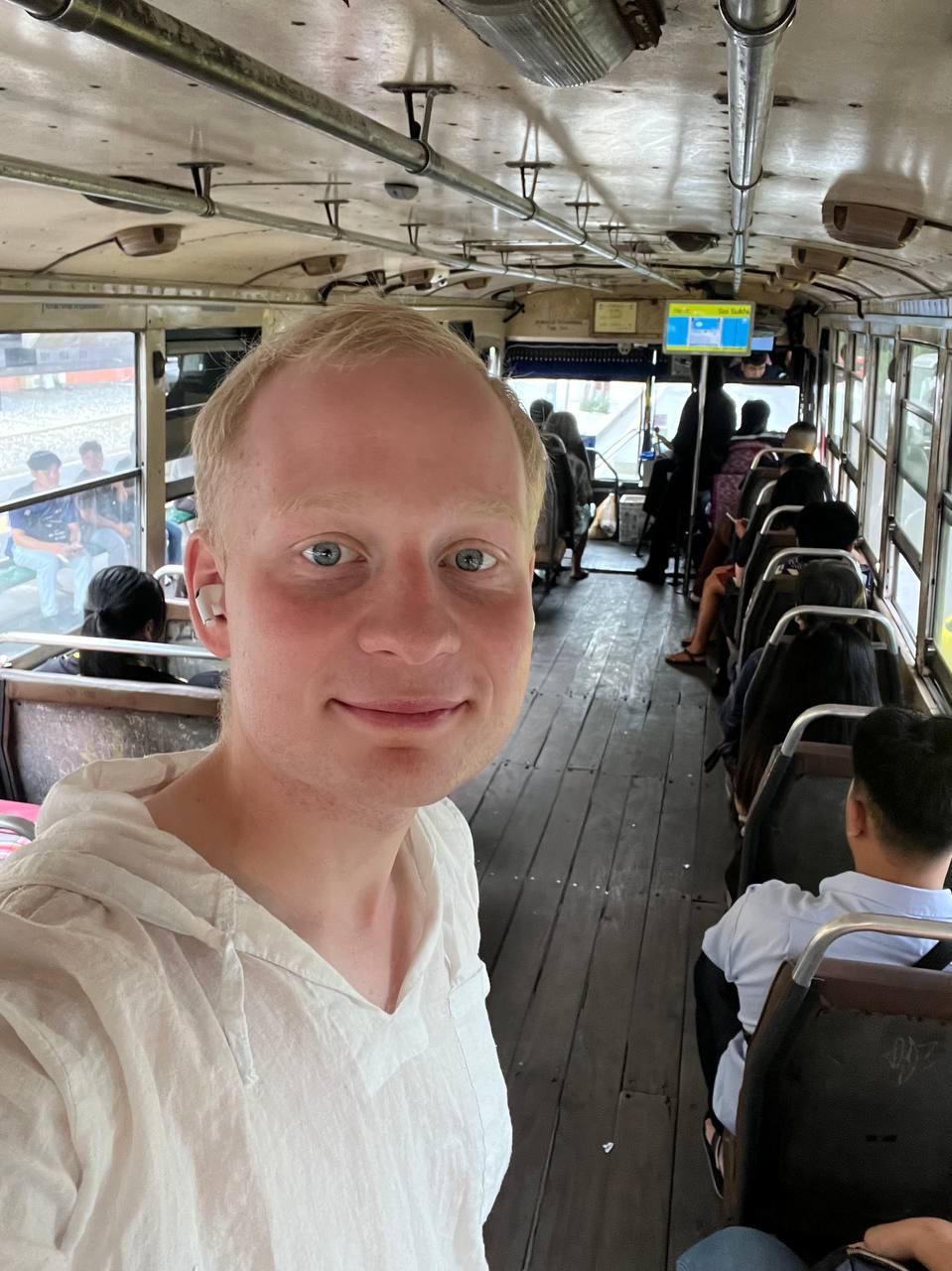
There's one problem: traffic. The bus sits in it with everyone else, and routes often loop in strange ways — what BTS does in 20 minutes, the bus might take 90. Schedules barely exist, stops aren't always labeled in English, and drivers don't announce stations.
The ViaBus app is good — it shows where each bus is and how long until arrival. Even with it, the bus stays a transport for people with lots of time and little money.
I almost never take buses, but occasionally I do on purpose — it's an interesting way to see the city from the inside, through a window, at walking pace. As a tourist activity, fine. As a way to make a meeting, no.
Guys in orange vests stand on every corner, especially outside BTS and MRT exits. These are the motorcycle taxis — the main weapon against the last-mile problem in Bangkok.
A short ride within a neighbourhood runs 10–40 baht. The price is usually fixed and posted on a board at their parking spot (in Thai, but the digits are Arabic). For longer trips, ask the price upfront and bargain.
Helmets. Legally required, in practice it's a coin flip. I usually wear whatever they hand me, if they hand me anything. I don't carry my own. That's a compromise, and I'll call it what it is — a compromise. If safety matters to you, take Grab Bike instead, where helmets are always provided.
My personal pattern: evenings and nights — moto-taxi. Cooler air, drivers are less burnt out, prices are the same. Daytime in the heat — Grab Car with AC.
I'll be blunt: tuk-tuks are tourist scams with a romantic glow. 100–300 baht for a ride that would cost 60 on the meter. No AC, loud, and you sit in the same traffic as everyone else.
Riding one once for the experience is fine. Agree on the price before you get in — never sit down without a confirmed number. The classic route to Wat Pho or Khao San Road is fine, but bargain the asking price down by at least half.
The main thing: don't fall for the "special offer" where the driver takes you to a suit shop or jewellery store and gets a kickback for bringing you in. It's a thirty-year-old scheme and it still works.
If you want something authentic, take a motorcycle taxi. That's real Bangkok, no theatre.
| Transport | Cost | Speed | Foreigner-friendly |
|---|---|---|---|
| Own motorbike | ~42 THB/L | Fast in traffic | License required |
| BTS/MRT | 17–65 THB | Fast | Very easy |
| Grab Car | 80–300 THB | Traffic-dependent | Very easy |
| Metered taxi | 60–300 THB | Variable | Some experience |
| Motorcycle taxi | 10–40 THB | Fast | Manageable |
| Bus | 8–25 THB | Slow | Hard |
| River boat | 15–60 THB | Fast on the river | Some experience |
My current mix looks like this. 80% of trips on my own small motorbike. 10% Grab, when it's raining or I need a car. 5% BTS, when I'm heading somewhere with nightmare parking (Siam, Silom). 5% moto-taxi, when I'm stranded somewhere without my bike. River boats are a separate story — I wrote a dedicated guide on river transport, and it's genuinely fast for routes along the Chao Phraya.
If I were arriving in Bangkok tomorrow from scratch and without a bike, my plan would be: week one — Rabbit Card on BTS plus Grab. Week two — try moto-taxis and the MRT. After a month, if I'm staying — start thinking about a scooter. Two months — learning and getting the license. Three — riding myself.
There's no one-size-fits-all transport in Bangkok. There's a toolkit, and the good news is most of the tools work. The bad news is that figuring out when to use what takes a few weeks. This guide is an attempt to shorten that learning curve.
BTS plus Grab. BTS covers the main tourist and expat areas — Sukhumvit, Silom, Siam. Grab handles everything else, with no haggling and no need to explain the address. Once you've settled in, add motorcycle taxis and MRT to the mix.
Easily. I know people who've gone years on BTS, MRT, and Grab alone. A motorbike makes sense if you're doing 15+ km daily and refuse to sit in traffic. For a tourist or someone new to the city, it's pointless and risky.
No. BTS is the elevated Skytrain, MRT is the underground metro. Different operators, so transferring between them means exit, walk, new ticket. The Rabbit Card has worked on both BTS and the MRT Blue Line since 2020, which helps.
Once, as a novelty — sure. As actual transport — no. More expensive than a metered taxi, hotter, slower in traffic. If you want something authentic, take a motorcycle taxi: cheaper, faster, and that's what locals actually use.
If you're planning day trips, Ayutthaya by train is worth the effort. For somewhere to walk in the city itself, Lumpini Park is one of the best starting points, and it's easy to reach by BTS Sala Daeng or MRT Lumphini. More on the country in the Thailand section.
Part of the series
Bangkok Expat Guide 2026: Long-Term Living in the City


